

Quick answer
A single well-timed night in Tromsø carries roughly a 50–60% chance; across three nights with mobile guiding, the cumulative odds rise to around 90%. The core viewing window runs 21:00–02:00, closest to magnetic midnight. Cloud cover, not geomagnetic activity, is the usual spoiler — Tromsø sits inside the auroral oval, so the sky above is active most clear winter nights.
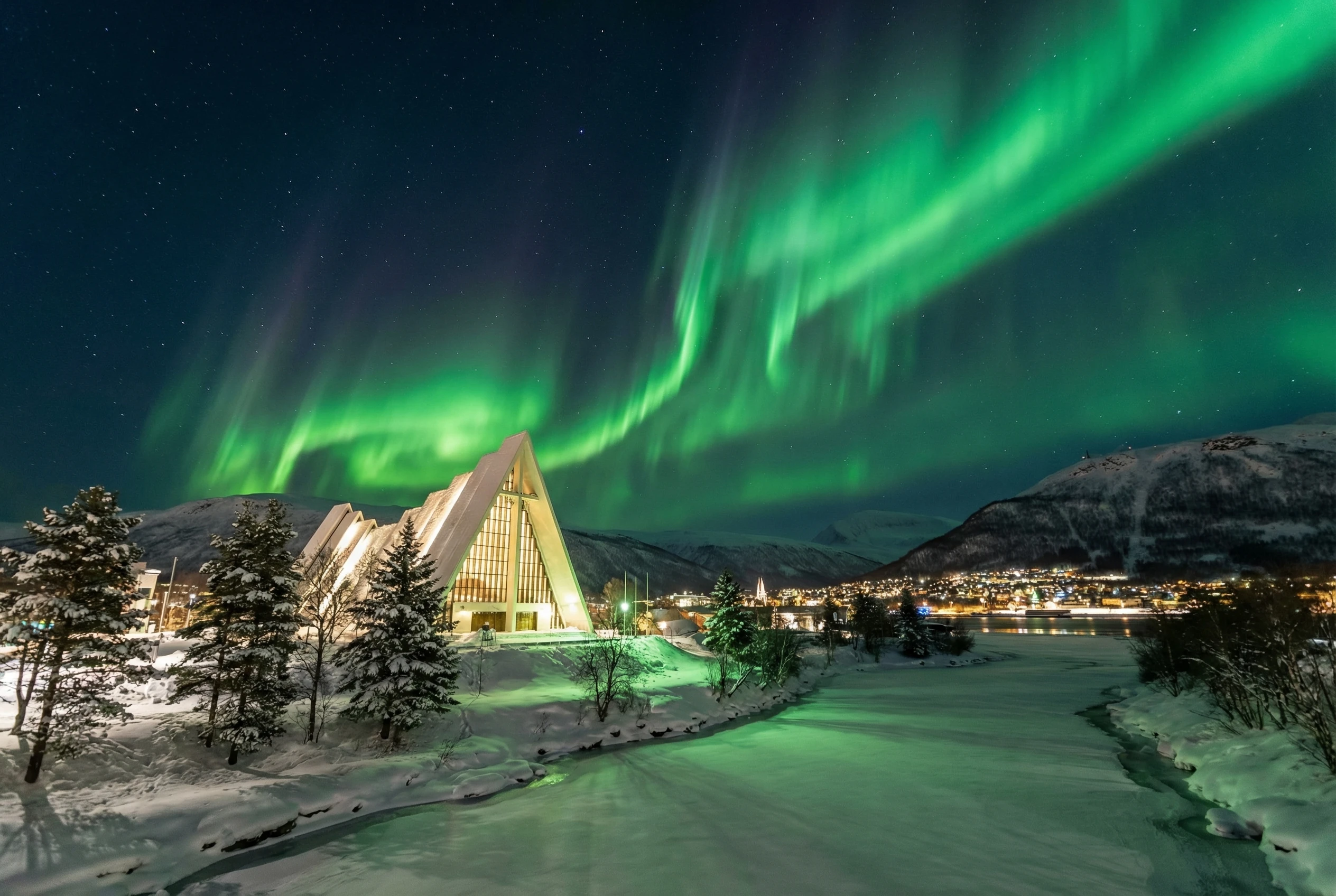
Tromsø receives roughly 3.3 metres of precipitation-driven cloud-heavy weather a year at sea level, and yet it remains one of the most reliable aurora bases on Earth. The reason is geographic rather than meteorological: the city sits at 69°N, directly beneath the auroral oval, the permanent ring of charged-particle activity that circles the magnetic pole. The oval does not need a solar storm to switch on. On a quiet night with a Kp index of 1 or 2, the aurora is already there — a pale green arc across the northern horizon, often mistaken for a cloud band until a camera confirms it. This is why the chances of seeing northern lights in tromso are structurally higher than in Reykjavík, Rovaniemi or Abisko, all of which sit further from the oval's core. What varies is the sky between the observer and the phenomenon. Coastal Tromsø, exposed to the Norwegian Sea, draws in frontal cloud that can sit over Tromsdalen and Kvaløya for days. Twenty or thirty kilometres inland, past Lyngen or east toward the Finnish and Swedish borders, the maritime influence weakens and the cloud thins. The entire logic of a northern lights chase from Tromsø rests on this gradient: the guide is not hunting the aurora, which is already overhead, but hunting a gap in the cloud. Operators monitor satellite imagery through the afternoon and commit to a direction before departure, sometimes crossing into Finland on a single evening. The practical consequence for planning is arithmetic. Treat each night as an independent draw at roughly even-to-favourable odds, and the probability of at least one sighting climbs steeply — two nights, then three, then four. Most guided operators quote near-certainty at four nights, and the pattern holds across seasons from the return of darkness in late September to its loss in early April. Visitors researching aurora viewing in Tromsø often over-index on the Kp forecast and under-index on nights booked; the second number moves the outcome far more than the first. Use the odds as a scheduling instrument, not a guarantee. Build a stay that allows several attempts rather than one, keep the 21:00–02:00 hours free, and accept that a mobile chase may run long. Understood that way, the chances of seeing northern lights in tromso become something a traveller can influence directly through the shape of the itinerary.
“The guide is not hunting the aurora, which is already overhead, but hunting a gap in the cloud.”
Pre-Visit Checklist: Preparing for Your Chances of Seeing Northern Lights in Tromso
Aurora chases from Tromsø mean standing still outdoors in sub-zero air for hours, so preparation is mostly about staying warm enough to keep waiting.
-
Order thermal base layers weeks ahead — Merino or synthetic long underwear is hard to buy locally in winter.
-
Reserve an insulated thermal suit — Most operators lend full-body suits, but stock runs out on busy nights.
-
Pack insulated winter boots, not sneakers — You will stand on snow or ice for long stretches without moving.
-
Bring two pairs of gloves — Thin liners let you work a camera while thick mitts restore heat.
-
Charge spare camera and phone batteries — Cold drains lithium cells within minutes, often mid-display.
-
Pack a tripod and headlamp — Long exposures need a steady base, and red light preserves night vision.
-
Carry a thermos and snacks — Waiting outdoors between 21:00 and 02:00 burns energy and body heat.
-
Add wool socks, hat, and neck gaiter — Extremities and exposed skin fail first at Arctic wind chills.
Clearing Common Myths About Your Chances of Seeing Northern Lights in Tromso
Misconceptions often arise from social media photography and a lack of understanding regarding atmospheric conditions. Clarifying these expectations helps visitors prepare for the reality of aurora viewing.
MythThe northern lights always look like vibrant green curtains to the eye.
FactThe human eye often sees auroras as faint, white, or gray bands because our night vision is less sensitive to color than camera sensors. High-intensity displays can reveal color, but cameras frequently amplify these hues beyond natural perception.
MythIf the sky is cloudy in the city, there is no chance to see the lights.
FactWeather conditions vary significantly across the region, which is why guided chases travel to different microclimates to find clear skies. Strategic mobility often overcomes local cloud cover.
MythA high Kp-index guarantees a sighting in Tromsø.
FactWhile a high Kp-index indicates geomagnetic activity, clear skies and darkness are equally vital for visibility. The best arrival window is 21:00–02:00 to maximize potential during magnetic midnight.
Common Mistakes That Reduce Your Chances of Seeing Northern Lights in Tromso
Most missed aurora nights in Tromsø come down to where you stood and what you failed to check, not bad luck. These are the errors that cut your odds the most, and the concrete fix for each.
Watching from the city centre or a lit harbour
Streetlights in central Tromsø wash out all but the brightest displays. Move to an unlit spot away from the harbour and main roads, or join a guided chase that drives to darker ground.
Ignoring the cloud forecast and staying put under overcast
Check the Norwegian Meteorological Institute cloud cover maps (yr.no) before committing to a location. Clear sky 100 km inland or toward Finland often beats a clouded coast, so be ready to travel.
Never checking the Kp index or solar activity forecast
Look at a 30-minute aurora forecast such as NOAA's OVATION model or a local Kp feed each evening. Low activity plus clear sky can still deliver a faint arc worth waiting for.
Giving up after 20 minutes outside
Aurora comes in bursts with long quiet gaps. Plan to stay out across the 21:00–02:00 window rather than stepping out briefly and concluding nothing is happening.
Assuming there is a venue or ticket desk to visit
There is no building or gate here — the address is simply Tromsø, Norway, and entry to the sky costs nothing. Access is through guided tour operators, so book a departure in advance rather than turning up somewhere.
Trusting a single night to deliver
Weather changes fast on the coast. Allow three or more nights in Tromsø so one clouded evening does not end your chances.
Admission Fees and the Chances of Seeing Northern Lights in Tromso
The northern lights are a natural phenomenon occurring in the sky above Tromsø, Norway, and therefore carry no admission fee. Costs only arise if you choose to utilize professional guided chase services to reach optimal viewing locations.
The northern lights themselves are free, with total costs depending solely on whether you book a private or group guided tour.
Check availability
Common Questions About Northern Lights Viewing in Tromsø
Everything you need to know about chances of seeing northern lights in tromso